Monday, 4 August 2025

Czech Balcony Tomatoes


Saving seeds from Aztek tomatoes

I grow at least 30 tomato plants every year and like to grow unusual heritage varieties. I have found Czech tomato varieties to be particularly good for growing outdoors in my British garden. I think this is because unlike varieties from southern Europe, the Czech varieties are used to having a short growing season and cooler weather. 

A particular Czech speciality is 'balkonovy' tomatoes - tomatoes designed to be grown in pots on the balconies of Czech flats. In fact two of my favourites can even be grown on a window sill. These are Aztek (a lovely yellow cherry tomato, see photo) and Vilma (a red tomato). They are described as dwarf or micro-dwarf tomatoes - they grow to about a foot tall (30 cms). Despite their limited height they are remarkably productive and the fruit is really tasty.

I brought the seeds back from the Czech Republic before Brexit restrictions hit and I have been saving seeds from my plants ever since. As always I have more seeds than I need each year and so I share them with two seedsaving groups I belong to. They have proved very popular. Their small size means that you can grow them anywhere sunny where there's room for a pot and they work really well at the front of flowerbeds. 

Aztek and Vilma seeds are now available online in the UK from She Grows Veg, they're not cheap but of course once bought you can save seeds for future years, as I do, as both are heritage varieties. 

If you are interested in a normal height Czech tomato - try Stupice (Stupicke Polni Rane) which is available from a number of online sellers. It is early to crop, goes on until the last frost, and is very tasty.  

Sunday, 1 June 2025

Hannah's Peony - a poem


Next to the front door at Hannah's lake cottage was a spectacular peony. After she died and before the cottage was sold, I dug up part of the plant and moved it to the garden of my Czech home, where it flourished. I was unable to take the plant with me to England, when I moved back, so have bought a similar one in memory of her - not quite the same, but the best I can do.

Here's a poem I wrote on the subject. It was first published in Dawntreader magazine (Indigo Dreams).


Hannah’s Peony. 

By the tumble of stones the peony
too red to be natural, too bloody
to be anything but
a token of things to come, and yet of itself
a now thing
bursting into flowered song
 
each petal a note
until they fall, stripped by rain
or just exhaustion,
the quick decline of the perfect,
and helmeted seed heads stand instead
until they too must bend to the seasons.
 
How it had blazed, asking
for nothing but a place in the earth.
 
When you died I dug up a piece of you –
this flower too bright to live –
planted it by the ruined woodshed,
surrounded it with stakes
to protect against the deer’s rough tongue.
 
And so each year this witch flower
burns again.

Sunday, 9 March 2025

Going back to Prague


As you will know from previous posts the Czech Republic has always been inspirational in my writing. My latest project (although it is a project already several years old) is a poetry collection about the country and my friend Hannah Kodicek: my relationship with both and their loss. 

I am currently stuck. I have a reasonable number of poems that are inspired by South Bohemia and my home there, but I have very few about Prague. And yet Prague was where I first fell in love with this country and where I first felt its inspiration. For many years now Prague has been somewhere I went through on my way to somewhere else or at best somewhere I was showing someone else around. How could I rekindle my poet's response to the city?

I decided to make a visit to the city with a view to writing, to remind myself of some of the feelings I first had when Hannah introduced me to her home city in March 1990. This is the last day of my six-day visit. And I can tell you it hasn't worked or not yet at least. 

This photo above is symbolic of the task I have set myself. It is of the statue of a girl with a dove in Park Holubicka. I first stumbled upon it in 1990 and was enchanted. I was completely alone and snow nestled on her head instead of a pigeon and muffled the air. I made a point of seeking out the park a few days ago, but as you can see I was far from alone - the park benches were full of noisy people, many of them tourists, and the magic just wasn't there. I suspect I need to come either early in the morning or late in the evening to get what I am looking for. Perhaps I am looking for something that is lost. Or maybe it was simply the gloss of memory and never was. But I don't believe that, Prague's deep soul could not be so easily mislaid. 

Sunday, 14 January 2024

Revisiting the House 1


I apologise for the gap in posts. You must have thought I had given up on this blog, and maybe I had. Maybe having sold the house and been confined to the UK by Covid, bad knees and back it hurt too much to look at what I had lost/been forced to give up. It did and does hurt. 

In November 2022 I did return to my little Czech village, staying in the house of my puppetmaker friend directly opposite my old home. It felt very strange to cross the bridge across her drainage moat and look at the bright lights shining out from my old home. In the November gloom the house was a beacon on the lower slopes of the Lisci Dira hill. I saw it as I crowned the hill on the track I took on my walk home from the bus, calling me down to the village and yet not calling me, because it was nolonger mine. 

In the house someone else was stoking the stove, someone else was chopping onions and making goulash, someone else was talking to her friends. Someone else but not me.     

Thursday, 18 February 2021

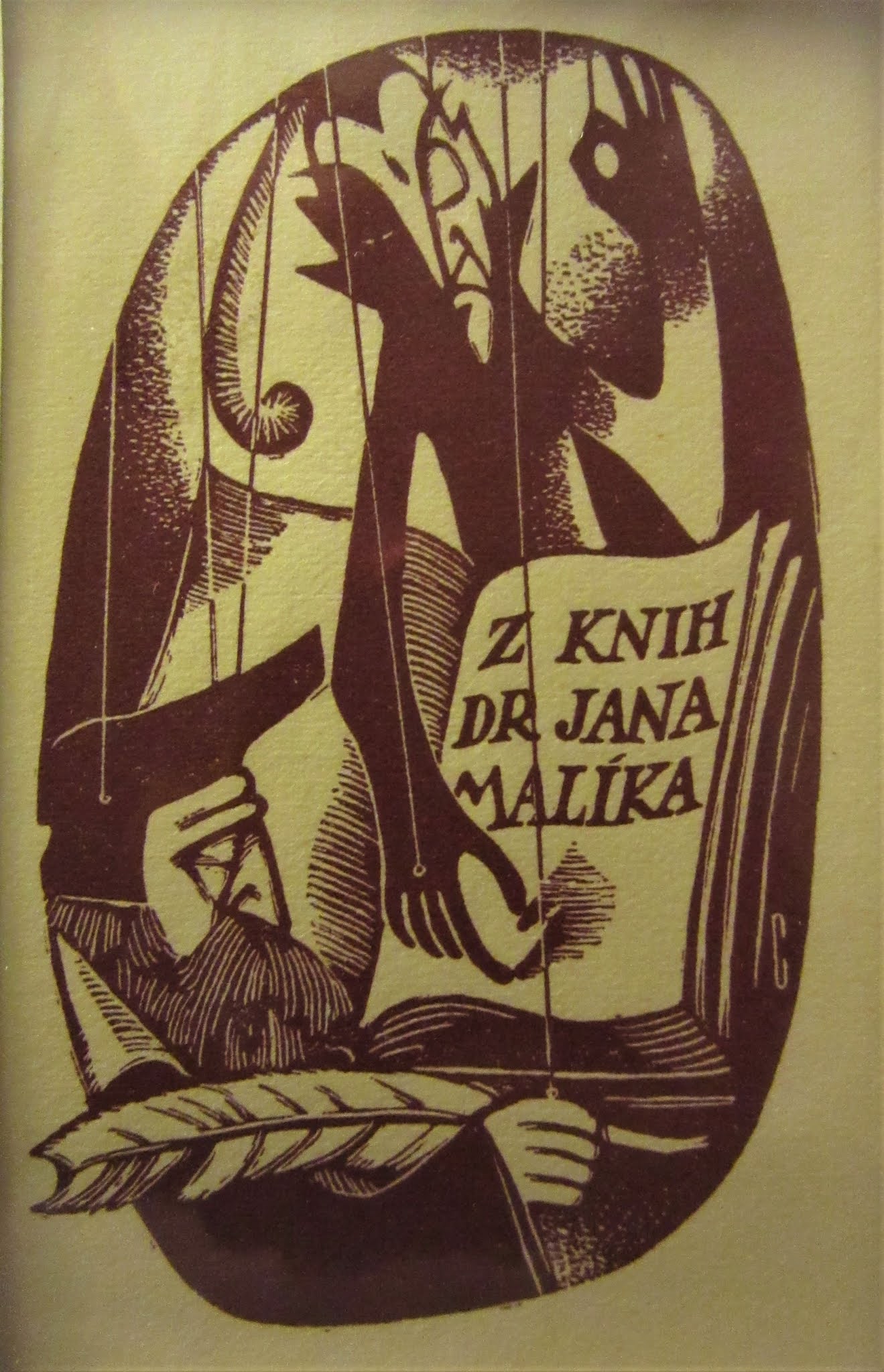
Czech Prints - Puppets


I was talking to my son this afternoon via Zoom and we came to the topic of Czech prints of puppets. As those of you who are regular followers of this blog will know, the Czechs are experts in the making of puppets. We had a wonderful puppet maker as a neighbour and I first met my friend, Hannah, when I went to her flat in London to borrow some puppets she had made. Anyway I promised my son I would share with him some of the puppet prints from my collection of Czech graphics.

The print above is by Vojtech Cinybulk (as are the three immediately below). Cinybulk wasn't just an artist of puppets, he was active in puppet theatre, which no doubt accounts for how many puppet prints he produced. 


It is not generally known in the UK that Dr Faustus was widely performed as a puppet show in Europe.


This print is by Lander.


The next two prints are by Mahulka. A regular character in children's theatre is Kaspar, a marionette boy. 


Here he is again, this print is by Grmela


and again by Borek


But this delightful little fellow has evolved from a more raucous immoral character that stems from the same roots as the British Punch. The change was driven by a change in target audience, with many middle class families having their own set of puppets.  

But puppetry in the Czech Republic has never just been for children. From the cautionary tale of Faust, through the devil-beating Kaspar, to the surreal puppets of Svankmajer, Czech puppets have always also appealed to adults. They have always had a subversive element. The Nazis suppressed puppet performances, although brave puppeteers continued to perform in secret. Over 100 puppeteers and puppet writers died under torture or in concentration camps. The Czechs rightly take puppetry very seriously.


Wednesday, 20 January 2021

Czech Prints - Owls


I am mindful that I have not blogged here for a while. I have been unable to get back to the Czech Republic for a year now because of Covid 19 restrictions, which makes blogging difficult. However I do have an extensive collection (over a 1000 items) of Czech prints, mostly ex libris or PFs, which could stimulate an interesting series of posts - either about the subject matter or about the artist. 

I am going start the series with a post about a subject dear to my heart - owls. When I was nearly three, my family moved house. My father took me exploring the garden, an event that has stayed with me to this day. The previous owner had kept owls in the old stables that sat at the bottom of the garden of our rather normal terraced house and Dad showed me the pellets. The experience is the subject of the poem that gave my newly published poetry collection its title. The poem appears at the bottom of this post. 

Ever since then I have had a love of owls and it seems that the Czechs have too, as owls feature in quite a few prints in the collection. Here are a few of my favourites: 

This is by Hanak, it's just one in a number of owl exlibris by the artist.

This by Plechaty

This by Rajlich

This is by Svolinsky

And this by Bugan. 
You will notice that this ex libris and the one by Hanak are for the same patron. You often find that patrons will commission different artists to create work on their favourite themes. Dr Pribys obviously loved owls. 

In case you are wondering the print at the top of this post is by Palenicek.

Here's the poem. If you are interested in buying the book, it is called Owl Unbound and is published by Indigo Dreams Publishing -  https://www.indigodreams.co.uk/zoe-brooks/4595048690. I have a number of copies to sell (signed if you want), just email me on zoe.brooks@googlemail.com to buy a copy. 

Owl Unbound

First we found the snake
a ball of coiled skin and muscle
in a pickling jar at the base of the hedge.
 
I followed my father up
the outside stair to the stable loft,
on one side the railway signal
without a track,
on the other a brick wall,
pocked as the moon,
that would crumble
like cheese in the rain
under the thud of my ball
and send it flying sideways
escaping me.
 
The tread creaked as my father entered
and I followed into the dim.
I looked around, but saw
only an empty perching post.
The owl had gone with its master.
 
At my father’s instruction
I held out my hands
as if ready to receive bread and wine,
but into my bowl of fingers
he dropped a pellet,
a galaxy of small bones and feathers
cocooned in fur.
 
That night I woke.
The moon shredded by clouds
hung over the stable roof
and an owl called unbound
from the cypress tree.


Sunday, 10 May 2020

The Carpenter - Frantisek Jesus


I am sometimes asked how I found our Czech house. The answer is Hannah's carpenter - Frantisek. She told him I was looking and he took it upon himself to find the right house for me. When I said how it called to my soul, he did one of his mysterious smiles and said "Vim" (I know). That comment pretty much summed him up. He was a man of very few words, seldom more than two left his lips at any one time. But he had a spirituality that was beyond words. The first time I met Frantisek was when he was playing Jesus in the Horice na Sumava Passion play - a part he was made for. Hannah and I joked that he was so into method acting that he never came out of character. To my husband and me Frantisek is always known as "Frantisek  Jesus."

Frantisek was an artist rather than a carpenter. I remember how he stroked the curve of a desk he made for Hannah out of one plank of wood. Nothing Frantisek made was ever quite straight, which was a problem if you wanted him to make a door, but not if you wanted something beautiful. How I wanted him to make me some furniture. But first the house needed repairing, and after a disaster in which he removed my windows to repair without numbering them, I was disinclined to offer him precision work.

One day he arrived excited that he could source some wood cheaply for Hannah and me. We both ordered a load of rough hewn planks - Hannah chose oak and I elm. Mine were piled in the barn to wait the time when they could be transformed into furniture. Very soon I discovered that mine had woodworm, something elm is prone too. Woodworm didn't seem to worry Frantisek over much. On a visit to his house and workshop in Horice, I found my feet sinking into the floorboards they were so wormy. When I finally left my Czech home, the elm planks remained unused and were only fit for firewood. I never did get the chance to own one of Frantisek's quirky bookcases.

Over the years Frantisek would occasionally turn up for a wordless visit. But then his visits stopped. When I asked my neighbour, a mutual friend, she told me that Frantisek had been working in Germany (something many local craftsmen do) and that one day coming home over the Sumava mountains and probably tired after a long week of work, he mistook a tight bend and drove into a tree. His son who was with him was thrown clear, but Frantisek was killed.


I shall always be grateful for that silent, strange and wonderful man. When I left my Czech home I left a carving, the only thing Frantisek made for me, a self portrait of Jesus. It was too heavy to take on the plane and besides I very much felt that it should stay there.


Tuesday, 24 March 2020

Little things


One thing being in the Czech Republic gives me is a tendency to observe more closely those little things, that usually I pass by. There I was walking around the square in Telc, a place bustling with tourists, when I observed these little eruptions between the cobblestones. They were everywhere.

Czech cobbles are bedded in sand and the gap between them had made a perfect place for solitary miner bees to excavate their nests. In burrows, under the tourists' feet, the bees had built egg chanbers, furnished them with a sack of pollen, and laid their eggs. Now the new bees were hatching unobserved by all but me and launching into the air to feast on the flowers that decorated the square. 

Thursday, 12 March 2020

Smallholding


When the purchasers of my house first visited, they asked about the land around the house. On hearing that it had always been rented to the house owners by the council, they got very excited about being able to grow vegetables and fruit. The dream of having a small holding is one that Czechs hold dear. A few may want flower gardens, but many want to have sheep or goats in the orchard, chickens and rabbits in lean-to shelters, and potatoes, squash, cabbage and beans in ground. Go into a country dweller's home in winter and you will find jars of tomatoes, soft fruit, sauerkraut, and potatoes in sacks, stored apples, onions and garlic. As a builder once told me "All a Czech needs for the winter is potatoes and cabbage." He should have added beer, but that goes without saying.

I tried to join in this dream of self sufficiency by planting fruit bushes, but was not in the country enough to fight off the deer and birds that raided my garden. I was soon disillusioned of my rosy ideas of the rural idyll - growing food was a battle, but rearing animals for food was more demanding.

This was made very clear to me one day. I was standing at the bathroom window cleaning my teeth, when I saw my neighbour take one of the rabbits from the hutch. I watched as he killed it, hung it from the apple tree to strip it of its fur and gutted it. He had spent all summer carefully picking dandelion leaves specially to feed it and yet he was brusk even brutal when it came to killing the animal. I was shocked, this was so unlike my gentle giant of a neighbour. It made me think about my attitude to meat. I had never seen an animal killed for food before, although I eat meat. Mine is the first generation in my family that have had the luxury of ignorance. My mother remembered the killing of of the family pig and no doubt other animals. My grandmother talked in great detail of the flurry of activity that followed the pig's death, including the making of those famous Lincolnshire sausages. Wasn't the Czech approach more honest than mine?

Monday, 27 January 2020

Lety


On this the Holocaust Memorial Day this post is about the concentration camp at Lety close to Pisek. 

Lety was built as a labour camp for criminals by the Czechoslovak authorities, but in 1942 it was designated by the Nazis as a camp for "gypsies and gypsy half-breeds" of which there were 6500 registered in the country. The camp's capacity was increased to 600 inmates, but that was soon exceeded: by August 1100 men, women and children were crammed into thin-walled wooden huts. In December 1942 typhus broke out in the unsanitary conditions and lasted until the camp was closed in summer 1943. 326 people died at the camp, including all the 30 babies born there. The rest were transported to Auschwitz/Birkenau and the final solution of the "gypsy and gypsy half-breed question".  Only 600 Czech Roma survived the Holocaust or the Devouring as the Roma call it.

Lety camp 1942 (photo: Museum of Roma Culture.)

Lety has been a sore in the history of Czechoslovakia. There were many who argued that it was simply a labour camp for criminals and sadly there still are people who believe this. The camp guards were employees of the police force of the Protectorate of Bohemia and Moravia, not German SS officers. The brutal treatment of the prisoners went unpunished after the war. Over the decades since the war the Roma have had to fight for the removal of a pig farm built on the site and for a memorial to be erected to the dead. The Roma and Sinti remain the forgotten victims of the Holocaust.

This poem of mine was published in the second Poetry Birmingham Literature Journal at the end of last year:

RAINBOW OVER LETY

I view from a passing coach
the broken wheel of light
one end stuck in rutted clay,
one in forest loam.
Under the trees the leaves are flayed skin,
the roots whitened bones.

We move too fast to watch the light fade,
the dissolution of the arch into grey.
We, who are blessed with movement,
hurry past the stillness of the dead.
The restless ones rustle but cannot leave,
they for whom movement was everything


Monday, 13 January 2020

A Final Walk


Before Christmas I spent four weeks waiting to sign the contract for the sale of the house. In the end the signing took place on the morning of my departure date. So I am again in the Czech Republic to partially empty the house and sort various other matters.

So here I am sitting in a room that no longer feels like mine - there are no books, no cds, no pictures on the wall and very limited choice of food. I will be handing over my keys on Thursday, this is the end of my life in my Czech home. I have removed the brass fox doorknocker from the front door and for the first time I haven't seen my friend and mentor the local fox during my stay, although I am hoping he will come and say goodbye before I leave.

My lovely husband is with me for this last visit, for which I am very grateful as this is all proving very hard. Today was his birthday, so we took the early evening bus into Krumlov and had a meal at Nonna Gina's, the pizza restaurant we used to regularly visit with Hannah. Afterwards we took a walk through a nearly deserted town. It was just like it used to be, when first we visited the Krumlov. Without hordes of visitors and with wood smoke hanging in the crisp air, we could enjoy the atmosphere and beauty of the historic town, imagining that around the corner might appear someone from a time gone by. I haven't felt like that for a long time.

Thursday, 2 January 2020

Black Stork at the Swimming Pond


On the walk down to the train station I pass the swimming pond. The pond is now frozen over and soon the ice will be thick enough to skate on. But on hot summer days it is full of locals enjoying the cool waters. This is not a swimming pool as we Brits know it. It is fed by water from the local brook and is a place for nature as well as humans. In the spring and autumn the water is sometimes disturbed by carp rising to the surface and returning to the depths or by flies breaking the surface as they take their first flights. Occasionally a heron patrols the shallows and for a while an enterprising fisherman had a boat moored at its side.

I remember how there used to swimming ponds in England like this one. There was a ruined one a few minutes walk from my Cotswold town, where the more adventurous kids used to swim even though it was silting up. The rest of us would cycle to Stanway, where there was still an open-air swimming pond, with wooden changing cubicles and mown grass on the water. These attractions have all gone, no doubt considered unsafe and unhealthy.

A year or so ago I was walking past the pond when I was amazed to see a black stork wading in the water. Whilst white storks are a common sight in villages and fields throughout the country, the black stork is an altogether rarer sight. The black stork is a shy bird, avoiding humans and restricted primarily to the forests and lakes. I suppose I should not have been as surprised as I was, after all my village borders the Boletice forest, which for many years was a restricted area. But still I had never seen a black stork at the pond or indeed anywhere else before, and I have not seen one since.

Saturday, 21 December 2019

The House Gnome


This little fellow came with the house. He was here when we took possession of the place on that bright sunny November morning in 2005. He has stood watch over the approach to the front door ever since. In winter he wears a hat of snow, in summer his paint fades and blisters still more. At times he has guarded more than that. Keys were left under his feet and the person who was to retrieve the key was told that “our little friend has the keys.” When I leave this house for the last time, I will leave it under his watchful eye. Like those ancient household Slavic gods (the Domovoy), you can't easily part a gnome from his house.

Tuesday, 10 December 2019

Wolves or not


A friend and I were laughing recently about our mutual friend, Hannah, who always denied that wolves could be in the Czech Republic. But then she always denied that anything bad could be from the country. Even if she had a flu it was because you had brought it from England.

Wolves had been hunted to extinction here in the 19th century, indeed there is a memorial in the Sumava to the last one. The big bad wolf of the fairytales was banished to the forests of other countries. And yet, the memory of wolves lived on in folk memory. I felt it distinctly in the darkness of the forest I viewed from the window of that night-bound train in Easter 1990. I felt it as I lay in a bed piled high with duvets on those freezing nights of my first stay in the house. As I heard the pad of snow dropping from the broken roof I thought of wolf padding through the drifts at the rear of the house, the following day my imaginings were reinforced by fox prints enlarged by the melting of snow. Maybe that is why the first book I wrote here was called Mother of Wolves.

The big bad wolf is now officially back. He was first seen, caught on a trip-camera near Vyssi Brod barely twenty miles from here. Wild creatures do not respect lines on maps and once the physical barrier of the Iron Curtain had been removed it was only a matter of time before the wolves' wanderings brought them into the Sumava Forest and beyond. It seems only right that EU freedom of movement should extend to this beautiful animal, if not in future to Brits.

Wednesday, 4 December 2019

Sumava - The Sound of the Forest


I have been listening to a delightful radio programme on the BBC called Susurrations of Trees - susurration is the English word for the sound trees make. The programme does not just explore the sound made by different trees, but also the different words we have for those sounds - psithurism for example is the sound of the wind in the trees. Of course the Czechs also have a word for it, but they go one step further their largest forest is called the psithurism - The Sumava (pronounced shoomava). My home is on the edge of it; the little town where I catch the bus is called Horice na Sumava. 

The Sumava extends over the border with Germany, where it becomes the Bayerischer Wald ( the more mundane Bavarian Forest). This huge forest is the most extensive (over 54,000 hectares) in central Europe and has the nickname the Green Roof of Europe or sometimes the Green Lung of Europe. And I love it.

I have spoken in earlier posts of the importance of forests to the Czechs, that it has a role in the Czech mind that is equivalent to the sea to the British. Sometimes when I walk in the forest and a wind gets up I feel this connection strongly. The psithurism of the trees is so like the sound of waves that I could close my eyes and I think myself back on a British shore.

Saturday, 30 November 2019

Dreaming Of Houses


I sometimes dream of houses; I did last night. Hannah used to take the Jungian line on house dreams that they are not about houses but about the dreamer, with the various floors representing the dreamer's different levels of consciousness. I just note that they tend to happen when I am busy organizing something about my Czech house, not that the house in my dreams is my Czech house.

When I was buying and reconstructing the house, I dreamed a lot about squeezing through a crack and finding new attics - huge and full of lovely beams. Later I dreamed I was going round and round a house, still squeezing through cracks but into hidden staircases and secret corridors.

Last night I had a different dream. I dreamed that I was sitting with Eliska, and we were talking about how lucky we were to have such nice lovely neighbours. I referred to the ones who had bought and done up the other half of my house. This is interesting as my real house is detached from the neighbours'. Maybe my dream talk was of the potential buyers of my house, who are keen to develop the barn which is attached to the house. I understand their enthusiasm, I too had big visions for the barn and ran out of money. It is one reason I was happy to accept their offer. We will see if their and my dreams come true.

Sunday, 24 November 2019

Blogging


One wonderful thing about my life in this country has been this blog. I don't think I fully realized its importance to me until now. Writing the blog was my first step towards starting writing again. Hannah knew that and encouraged me.

Now as my stay in this country draws to a close, I have a wonderful record of my experiences, thoughts and feelings. My parents both enjoyed reading the blog. Much as they would have loved to they were too elderly to visit my Czech home, but the blog allowed them to share my adventures. And then of course there is you, dear reader. I thank you for all your support and feedback. I hope you enjoy the blog posts to come, because even when I leave the house, I will continue blogging about the Czech Republic. I have a list of blog-post topics I have yet to cover. The list of titles extends over several pages in my notebook! And of course I will be visiting Czecho regularly.

This blog is important in another way. I am working on a collection of poems about my love and experience of the Czech Republic. This is separate to the collection I will be publishing next year with Indigo Dreams. I have written approximately half the collection and am working on more poems. Without this blog triggering memories and feelings I doubt I could write the new material. Watch this space.

Thursday, 21 November 2019

Remembering Hannah


I am in a strange state of mind. I have returned to finalize the house sale. Unless things get delayed, which they might, this is my last stay in my home. I am already saying goodbye to places I have loved for years, and not just places.

As I walked through the woods with Helena, and again when I went alone up to the woods above my house, I found myself thinking a lot about Hannah who introduced me to the Czech Republic and all things Czech. I owe this whole Czech adventure to Hannah. I realised as I walked with Helena, that the route was one that Hannah and I had followed on my first walk in a Czech forest several years before I bought my house. The same was true of the woods above my home, where Hannah gave me my first lesson in mushroom collecting. Over the brow of the hill the woods drop down to the road to Lake Olsina, where Hannah had her cottage.

Hannah's main home was in Cesky Krumlov. She moved three times in that town, so everywhere there are reminders of her. Although she died in April 2011, those memories never used to bother me. I always took comfort from them. But now I am glad the willows planted on the island she fought for have grown so large that they curtain the view of her last home, where my memories are most painful.

Selling my Czech home seems like letting her down. When she was dying she worried that the little colony of Brits that had grown up about her would break up. I told her: no offence but I didn't just buy the house because of her and wasn't planning to sell up after her death. She was relieved by this. It mattered a great deal to her that I bought the house as a place to write poetry. She loved my poetry and wanted to encourage it. The visit I made with her to Prague in 1990 was the inspiration behind my poem for voices Fool's Paradise.

I was chatting to her son the other day, who told that his mother would have been delighted that my poetry had suddenly blossomed and that at last I have a book of poetry accepted for publication next year with Indigo Dreams (more of that anon). I know too that Hannah would have understood the fact that I now need to be in UK to pursue my poetry dream. And yet...

Friday, 15 November 2019

Mosquitoes, midges and other biting insects

Olsina Lake

As I was lying in bed the other night I watched a battle taking place above my head. Mosquitoes that had escaped from the cellar when I was fixing the pump now bounced over the ceiling. Whenever I turned off the light, their whine came closer and closer as they homed in on my scent. I knew I was in danger of waking with itchy red bites. Fortunately the ceiling was being patrolled by a number of thin legged spiders and harvestmen and I watched as they pounced on passing mozzies, the predator become prey.

I remembered evenings at Hannah's cottage next to Lake Olsina. I loved Hannah's cottage. Its position was idyllic, with the lake encircled by the steep hills and deep forest of the Boletice. But you always pay for such divine pleasure and in Olsina you pay with blood. As evening drew on there would be so many mosquitoes rising from the lake that the sound was thunderous. There was another danger at the cottage, horseflies. I remember Hannah commenting on what a beautifully marked fly had landed on her trousers, only to yelp as the fly's sharp mouth parts bit through the thick fabric.

The forests have their own pesky insects, most dangerous of all being ticks. These small insects, barely visible as they wander on your clothes and skin, will swell up as they suck your blood and be buried head first in your skin. As they can carry Lyme disease and encephalitis, I always spray myself with DEET-based insect repellent. I do that in the UK as well, as disease-bearing ticks have spread there too. Another annoyance are the midges that rise in clouds and bite any exposed skin. And finally there is a small black insect, which looks like a spider but has wings. I have not been able to identify it, but it has a sharp bite and is often a problem when I am mushrooming. Any suggestions as to its identity are welcome.

Anyway back to my bedroom ceiling, although the spiders were doing a good job, the number of mozzies was too much for them, so I resorted to chemical controls – sliding a tablet into the plug-in mosquito killer. Turning off the light I settled down to an unbitten sleep.

Wednesday, 30 October 2019

Squatters in the Septic


The other day I was clearing moss from around the hatch to the septic tank. I lifted the metal hatch to ease some moss out to find that we have squatters in the septic tank. One – a large toad – was on the ledge where the hatch sits. Further down what I think was a frog could be seen with its head stuck into a hole where the pipe from the cellar pump sits. It was just like a small child playing hide and seek – “If I can't see you, you can't see me.” A movement in the water revealed two more frogs or toads. Goodness knows how many there are living in the tank, as the area of water revealed by the hatch makes up not a twelfth of the water surface and no doubt there were more in the depths.

I was surprised by our squatters, as I had always thought the water coming from the house with its mix of detergent and other chemicals would have caused them problems. But I suppose the majority of the water going in is pure spring water and the silt at the bottom must be feeding all sorts of worms and other food. That combined with the protection from predators and cold weather, probably makes the septic an amphibian des' res'. I put the hatch back carefully so as not crush the toad and let my squatters get on with it.

LinkWithin

Related Posts Plugin for WordPress, Blogger...